Success Story
Exploring Credible Alternatives for Yemen’s Political Future
Yemen is often viewed through the lens of conflict and humanitarian crisis with little coverage of the country’s governance. Since the Houthis seized control of Sanaa in 2014, they have expanded their influence in the north with support from Iran, while deepening repression within Yemen. In the south, the internationally recognized government struggles to establish full sovereignty. Years of negotiations have stalled, mainly due to inconsistent international support. Yet recent events—including a U.S.-brokered ceasefire with the Houthis following their Red Sea attacks, Houthi strikes on Israel, and their support for Iran—have reignited global interest in Yemen’s internal politics and urgent need for credible alternatives to authoritarian rule.
On June 26, 2025, NDI convened a panel of four leading Yemen experts to discuss the central question: What is a viable political alternative to Houthi rule, and how can Yemenis and their partners work together to chart a credible path forward?
The discussion featured a blend of academic insight and lived experience. Asher Orkaby, Research Fellow in Near Eastern Studies at Harvard University, and Fatima Abo Al Asrar, Senior Analyst at the Washington Center for Yemeni Studies, provided overarching academic perspectives on the conflict’s impact on Yemen’s political landscape. Meanwhile, Abdelrazak al Hajri, a member of the Supreme Council of the National Political Bloc, and Kenza Aqertit, NDI Senior Country Director for Yemen, provided on-the-ground perspectives on the current political climate and best course for the future. The panel was moderated by NDI Middle East Regional Director Leslie Campbell, a long-time observer of Yemen’s political trajectory.
The panelists spoke to Yemen’s long history of pluralism and the impossibility of engaging with the Houthis as reliable or credible interlocutors in international negotiations. Orkaby highlighted how the Houthis have built power by weaponizing the political, economic and religious marginalization of northern regions prior to 2014, and by taking advantage of the humanitarian aid industry by seizing resources, imposing high fees on humanitarian organizations and undermining local agriculture. He argued that a decentralized, federalist model, with strong local governance and equitable resource distribution, may offer Yemen its best chance at long-term stability.
Al Asrar acknowledged the erosion of pluralism and political participation under Houthi rule but stressed that, while Houthis enforce ideological conformity in the regions they control, many citizens quietly resist and await change. Al Hajri criticized the international community’s past decisions to include the Houthis in Yemen’s post-Arab Spring national dialogue, likening it to legitimizing a “terrorist group” that has systematically dismantled political parties, silenced media and imposed a brutal, theocratic rule that suppresses civil liberties and minorities. However, despite the erosion of pluralism under Houthi rule, Aqertit emphasized that parties remain a vital force in Yemen’s political ecosystem. Many retain tribal, regional and historic legitimacy; are represented throughout the internationally recognized government’s institutions (the Presidential Leadership Council, Consultation and Reconciliation Committee, local and regional councils, etc.); and are well-positioned to serve as predictable and accountable interlocutors with the international community.
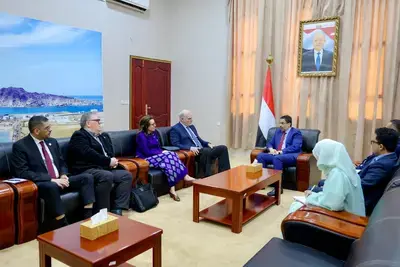
NDI has been working with leading Yemeni political parties and movements to reclaim space for dialogue, inclusion and representative governance. In April 2025, representatives of 22 participating parties and groups agreed to form the Yemeni National Political Bloc, a coalition committed to forging a shared vision for a peaceful Yemen while respecting its political diversity. Since its formation, the Bloc has worked to foster consensus and offer a credible, Yemeni-led alternative to Houthi rule.
The Bloc’s formation and increasing engagement with institutions, aligned with the internationally recognized government and others, is a step towards creating the conditions for a viable, more pluralistic political system in non-Houthi-controlled areas. With time, the Bloc aspires to serve as a reliable, predictable interlocutor who could represent the Yemeni people in Yemeni-Yemeni dialogues and as a voice for a more democratic and secure Yemen on the world stage.

Related Success Stories
View All