Paulina Chavez
Press Secretary
[email protected]
Resources
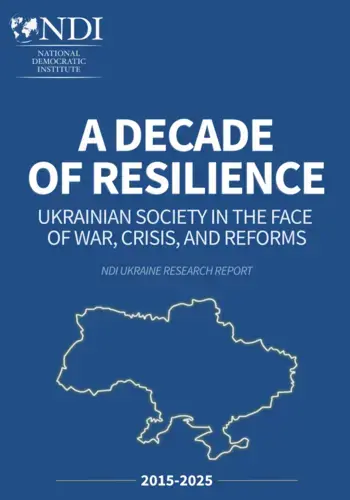
Over the course of 10 years, the National Democratic Institute (NDI) conducted regular nationwide polls, tracking public opinion related to political events and public trust in institutions during a tumultuous period in the country’s history.
Spanning the period immediately following the Revolution of Dignity (EuroMaidan) in 2014, to the landslide election of Volodymyr Zelenskyy in 2019, and the full-scale invasion by Russia in 2022, NDI’s longitudinal research reveals a population that has remained committed to its future as a fully functioning democracy, even as public confidence in specific institutions and individuals has waxed and waned.
In the attached report, NDI summarizes the findings of a decade of research, situating the results within the political and sociological context of the country, and drawing out research findings by thematic areas over time. Key findings include:
Stable Democratic Values but Shifting Trust in Institutions
Trust towards political and democratic actors and institutions in Ukraine has fluctuated significantly during the monitored period, with notable spikes driven by key events like the election of President Zelenskyy in 2019, a significant dip during the COVID-19 pandemic, and a broad resurgence with Russia's full-scale invasion in 2022. While political trust surged during wartime due to heightened national unity, it began to decline as the initial emotional intensity of the shock faded, and concerns over the direction of the war grew. Support for democracy remained strong throughout the period, with a growing demand for justice, fairness, and freedom of speech, particularly during the war.
Societal Expectations Towards the Future
Societal expectations also fluctuated significantly, influenced by key political transitions and the war. While optimism about the future peaked in 2019 following the election of new leadership, it was sharply disrupted by the pandemic and the full-scale invasion. However, national unity and resilience during the war sparked a renewed sense of hope. As of 2024, optimism has decreased slightly, reflecting the emotional and economic toll of the prolonged conflict.
Media Consumption
Media consumption in Ukraine has shifted dramatically, particularly with the rise of Telegram as a primary source for real-time updates and secure communication during the war. Use of traditional platforms like Facebook and Viber has declined, while YouTube has grown as a supplementary tool for information and entertainment. This change reflects broader shifts in media behavior driven by both the war and the growing importance of digital platforms in public discourse.
Euro-Atlantic Integration
Support for Ukraine's integration with the European Union and the North Atlantic Treaty Organization (NATO) has grown significantly over the last decade, particularly after 2019 and the 2022 invasion. Ukrainians increasingly view these organizations as essential to their future, driven by security concerns.
Support for Fair Representation
Growing local activism has pushed for fairer representation and, despite ongoing resistance and societal discrimination, public support for gender equality and LGBT+ rights has steadily risen. These issues have increasingly become part of the broader conversation on justice and human rights. The number of Ukrainians supporting equal treatment for LGBT+ individuals has more than doubled, while steadily increasing numbers want to see more women in politics. Obstacles remain, as traditional views on gender roles and expectations persist. Despite positive signs in sociological research, LGBT+ individuals still face substantial social and legal challenges. Additionally, the societal emphasis on celebrating front-line combatants can overshadow the vital contributions of those supporting the war effort in other ways, including maintaining the economic, social, educational, and familial structures. This in turn risks undermining recent progress towards gender equality made both before and during wartime.