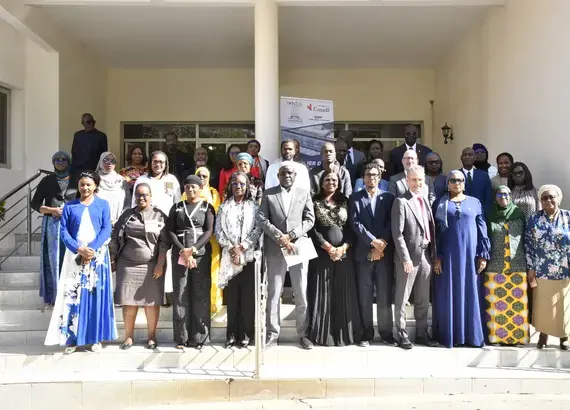
Participants and special guests following the opening ceremony.
Success Story
Advancing Efficiency and Transparency in Senegal’s National Assembly
Parliaments in functioning democracies are the beating heart of governance. They provide a forum for elected representatives to safeguard the interests of citizens, debate and pass legislation, and hold governments accountable to their citizens. At their best, parliaments translate citizens’ voices into policy choices that advance fairness, transparency and opportunity.
While Members of Parliament (MPs) are the key actors in these processes, they rely on professional support staff to perform their roles effectively. Skilled parliamentary staff facilitate evidence-based decision-making, foster effective public communications, and ensure legislative efficiency.
I have worked as a local language interpreter for the National Assembly for 11 years, and this is the first time I have been invited to a training like this one.
Local language simultaneous interpreter
Building Skills to Strengthen Senegal’s National Assembly
To support Senegal’s vibrant National Assembly, NDI organized a training for 75 parliamentary support staff and MPs in Dakar from January 28-30. Participants included parliamentary research assistants, committee rapporteurs, simultaneous interpreters and key administrative staff.
The three-day workshop provided a comprehensive overview of legislative processes and procedures within the Senegalese National Assembly, and in-depth discussion of the key roles and responsibilities of support staff in parliamentary proceedings. Following presentations in plenary sessions, participants undertook practical exercises, such as drafting committee reports and addressing cross-cutting demands, including accounting for the particular needs of marginalized groups in budgeting and other legislative processes.
An NDI expert in parliamentary operations highlighted lessons learned from National Assemblies across West Africa, leading participants to reflect on how national assemblies are organized and structured in Benin, Togo, Côte d'Ivoire and Senegal. These exchanges reinforced a shared regional commitment to strengthening democratic institutions and raising professional standards.
I've spent years walking right past colleagues in this room, but have never spoken to them or known exactly what they do. We need more opportunities like this one to get to know each other as a team and learn how our roles support each other.
Administrative support staffer
Elevating Voices From Within
For many participants, this was the first time in their professional careers to share their experiences and observations directly with National Assembly leadership, and to highlight hitherto underappreciated challenges.
Research assistants noted how the lack of well defined job descriptions often result in requests from MPs that are outside of their responsibilities. Committee rapporteurs expressed the need for standardized templates to facilitate reporting during important legislative debates. Local language interpreters underscored that, while multilingual simultaneous interpretation is available during plenary sessions, it is absent from critical committee meetings — where meaningful and substantive discussions take place. This gap can inadvertently sideline MPs from rural communities who primarily speak Wolof, Diola, Mandinka, or other local languages, limiting their full participation in legislative deliberations.
Through collaborative dialogue, participants agreed on nine key recommendations for National Assembly leadership aimed at modernizing and strengthening the institution. These recommendations represent practical steps toward a more transparent, representative, and effective legislature.
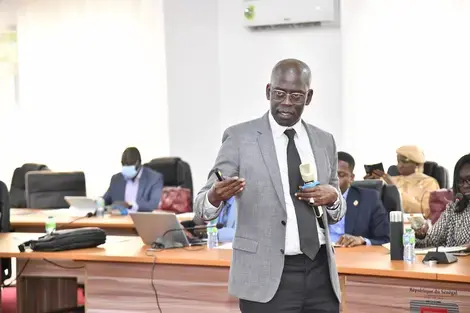
A senior technical advisor at the National Assembly explains to participants their role in the legislative process.
Advancing Reform and Institutional Impact
NDI’s training was designed to support ongoing institutional reforms led by President of the National Assembly El Hadj Malick Ndiaye, elected in December 2024 in a vote that brought an unprecedented number of freshmen MPs to the National Assembly. As part of broader efforts to increase legislative effectiveness and public trust, National Assembly leadership has doubled the number of parliamentary research assistants and intends to readjust the status of ad hoc parliamentary support staff by integrating them into the professional civil service.
NDI highly values its partnership with the Senegalese National Assembly as it pursues its reforms efforts. Stronger internal systems translate into better lawmaking, increased oversight and greater public confidence in democratic institutions. By strengthening staff capacity, clarifying institutional processes and promoting meaningful participation, this initiative contributes to a legislature that is better equipped to serve citizens efficiently and transparently.
This NDI program was funded by the Embassy of Canada in Dakar.

More Success Stories
View All