Thought Leadership
Holding the Line: How African Citizens Are Defending Presidential Term Limits
When African countries embarked on the third wave of democratization in the 1990s, many adopted presidential term limits as a safeguard against executive entrenchment and a return to autocratic rule. The enthusiasm was near-universal: 43 of the 45 countries with executive presidents on the continent adopted constitutional term limits, with only The Gambia and South Sudan as exceptions. The evidence since then has borne out the logic. According to the Africa Center for Strategic Studies, countries with effective constitutional term limits tend to perform better on accountable and peaceful governance, while countries without them are generally more corrupt and unstable, generating 90 percent of the continent’s refugees and internally displaced people.
And yet, despite the democratic promise and the broad popular support for term limits documented in Afrobarometer surveys, the record is sobering: term limits have been circumvented or outright abolished in 20 countries, only 16 have maintained them consistently, and seven others have yet to face a serious test [see table below].
While the prevailing tide shows presidential term limits as a casualty of the new rise of autocratic rule across the continent, several countries stand out — places where citizen engagement and institutional independence have allowed democratic norms to hold. What can we learn from them?
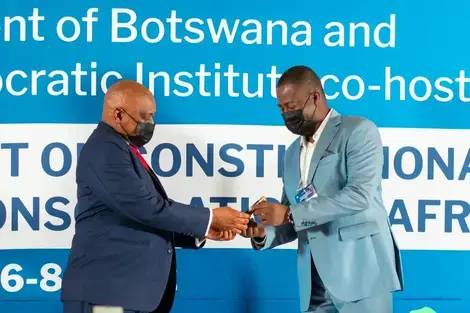
Former President Mokgweetsi Masisi of Botswana accepts the 'term limits baton' from civil society leaders in July 2022, signaling his commitment to respect presidential term limits in line with the constitution of Botswana.
Lessons Learned from Successful Resistance
Countries where incumbent presidents failed to remove term limits include Burkina Faso, Malawi, Nigeria, Senegal, the Democratic Republic of Congo (DRC), and Zambia. In each case, a sitting president intent on extending his time in power was ultimately stopped. The approaches varied, but the common threads are instructive. In Burkina Faso and Senegal, organized civil society action was determinant. When Burkinabe President Blaise Compaore moved to amend the constitution in 2014, a broad, cross-sectoral coalition mobilized to block the legislative vote and succeeded. In Senegal, citizen mobilization carried through to the ballot box: President Abdoulaye Wade failed to win a third term in 2012, and in 2024, massive public opposition stiffened the resolve of the constitutional court to rule against his successor Macky Sall’s attempt to postpone the presidential election indefinitely — a remarkable outcome in a context where the judiciary has often been perceived as biased.
Legislative action was the decisive factor in Nigeria and Zambia. In 2006, Nigerian President Olusegun Obasanjo failed to secure a majority for a constitutional amendment removing term limits — including among members of his own party — in no small part because civil society pressure had created political space for senators to break ranks. In Zambia, President Frederick Chiluba’s party controlled 87 percent of legislative seats and still could not secure passage of constitutional changes that would have allowed him to run again in 2001. In Malawi in 2002, ruling party defections ultimately forced President Bakili Muluzi to withdraw a constitutional amendment to remove term limits. In all three cases, large civil society coalitions created an environment in which ruling-party legislators ultimately chose constitutional fidelity over presidential loyalty.
In the DRC, a combination of widespread demonstrations, opposition within the senate, and diplomatic pressure led President Joseph Kabila to refrain from changing the constitution and step down in January 2019, after a two-year additional stay in office due to delayed presidential elections. Senegal and Malawi also illustrate how well-timed international pressure and democracy assistance, combined with a mobilized domestic opposition, can tip outcomes in the positive direction.
Conclusion
The removal of term limits is often the first step towards more autocratic rule. Effective resistance to such moves, by contrast, can help institutionalize the practice of peaceful transfers of executive power.
Term limits are not sufficient for democratic consolidation, but they may be a necessary condition — in Africa and elsewhere.
What the successful cases share is unambiguous: extensive citizen and civil society mobilization can provide a powerful force for accountability and constitutional constraint. Cross-sectoral coalitions — bringing together youth, union members, academics, lawyers and religious leaders — can provide the backbone that constitutional courts and dissenting voices among ruling party legislators need to hold firm. Even when a president succeeds in standing for an additional questionable term, citizens united around a common front have shown they can vote him out.
Domestic pro-democracy actors are determinant for effective term limits enforcement. But well-timed external support tends to strengthen their hand. This insight has inspired the National Democratic Institute’s (NDI) ongoing program since 2019, “Constitutionalism for Democratic Consolidation,” which provides technical assistance and coordination platforms to civil society organizations working to safeguard term limits and other democratic norms. Through regular interactions between civil society activists, academics, and political leaders, the program is helping build a continent-wide cross-sectoral network of constitutional norms defenders who are learning from one another, becoming more strategic, and collaborating organically around shared goals.
Table 1: Status of presidential term limits in Sub-Saharan Africa, Jan. 2026
| Term limits respected consistently | Term limits circumvented/ removed | Term limits yet to be tested by a president reaching end of final term | Term limits never introduced | N/A because of constitutional regime type [M monarchy, P parliamentary system] |
|---|---|---|---|---|
| Benin | Burkina Faso | Angola | The Gambia | Eswatini M |
| Botswana | Burundi | Equatorial Guinea | South Sudan | Ethiopia P |
| Cabo Verde | Cameroon | Guinea Bissau | Lesotho P | |
| Ghana | Central African Republic | Madagascar | Mauritius P | |
| Kenya | Chad | Seychelles | Togo P | |
| Liberia | Comoros | South Africa | ||
| Malawi | Congo Brazzaville | Zimbabwe | ||
| Mali | Cote d’Ivoire | |||
| Mauritania | DRC [two year extension of presidential term] | |||
| Mozambique | Djibouti | |||
| Nigeria | Eritrea | |||
| São Tomé and Príncipe | Gabon | |||
| Senegal | Guinea | |||
| Sierra Leone | Namibia | |||
| Tanzania | Niger | |||
| Zambia | Rwanda | |||
| Somalia | ||||
| South Sudan | ||||
| Togo [transitioned to a parliamentary system in 2025] | ||||
| Uganda |
Sources: ACSS 2018, Tull and Simons 2017, with author’s updates.

More Success Stories
View All