Success Story
The Architecture of Power: A Decade of Transformation in Kosovo
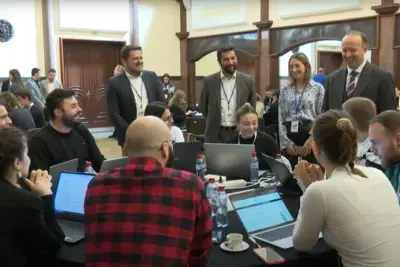
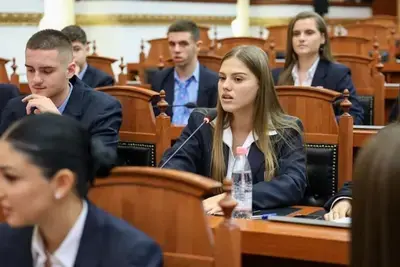
For over ten years, the Week of Women (WoW) has served as more than a conference; it has become a platform for shaping how leadership, governance and inclusion are practiced in Kosovo. Launched by the National Democratic Institute (NDI) in 2012, WoW has created a consistent and credible space to strengthen women’s political participation, ensuring that women are not merely guests in the halls of power but actively shaping decision-making.
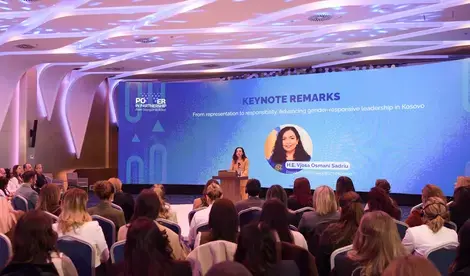
President Vjosa Osmani Sadriu delivering her keynote address at the opening conference of Week of Women 2026.
Doubling Down on Representation
At the heart of this narrative is a relentless commitment to strengthening women’s political representation. NDI’s global strategy to expand women’s participation and voice in political life finds vibrant expression here. By creating a space where over 1,400 alumni from all walks of life found their political footing, WoW is dismantling key barriers that have historically kept women at the margins of political power. Among Week of Women participants, over 100 have run for office, with more than 30 elected for local assemblies and at least eight to parliament. This effort is bolstered by other NDI initiatives like the #NotTheCost campaign, which works to end the physical and online violence that extracts a high price for politically active women, helping ensure that their participation is not only possible, but safe and meaningful. As Kosovo’s President Vjosa Osmani Sadriu reflected in her keynote address, the Week of Women has served as “a compass” throughout her political journey and as “a source of strength, clarity, and conviction.” She noted, “from the early days of my political path to the responsibilities of the Presidency, this space has been a source of strength, of clarity, and of conviction. It has been a place of grounding, a reminder of why we step forward, and who we carry with us when we do. The Week of Women is not simply an event. It is a living testament to solidarity, to resilience, and to the quiet but unshakable power of women who refuse to be absent from shaping the future. It has accompanied me through every chapter of this journey, and it has left a mark not only on my work, but on my sense of purpose”.
Accountability through Partnership
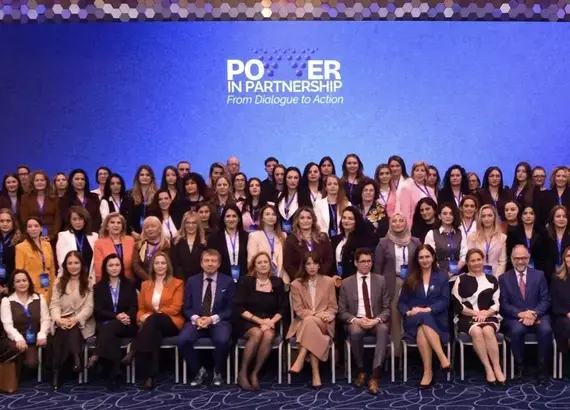
The WoW has responded to the political, social and institutional dynamics of the day, with priorities emerging from the realities and conversations shaping the political moment. This reinforces WoW as a space where ideas are co-created and ownership sits with those engaged in the process. Today, the transition from representation to responsibility is the next frontier. Under the theme "Power in Partnership: From Dialogue to Action," the 2026 edition emphasizes that true accountability is measured not only by commitments but by how policies are implemented, resources are allocated, and results are delivered for citizens. WoW increasingly serves as a bridge between dialogue and decision-making, connecting women and men leaders across political parties, institutions, municipalities and sectors. From economic inclusion and labor market participation to energy transition and local service delivery, the platform is helping translate priorities into actionable agendas and empowering women to influence decision-making across all areas of public life.
This approach is reinforced by NDI’s broader work in Kosovo, from leadership and mentorship programs to support for women candidates and local officials, to strengthening collaboration between institutions and communities. Together, these efforts are building a pipeline of women leaders who not only participate but also influence policy, improve accountability, and shape development outcomes.
By fostering cross-party and cross-sector collaboration, WoW demonstrates that representative governance is not an add-on but rather a prerequisite for resilient institutions, sustainable development and public trust. What began as a platform for dialogue on women’s political participation, leadership and representation has evolved into a mechanism for continuity, coordination, and collective action, ensuring that momentum for policy reform, institutional accountability, and intentional decision making translates into measurable progress.

More Success Stories
View All 
North Macedonia