Success Story
North Macedonia’s Parliament: Partnering for Openness and Citizen Trust
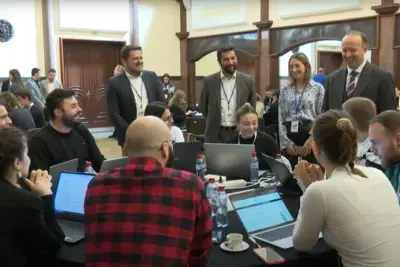
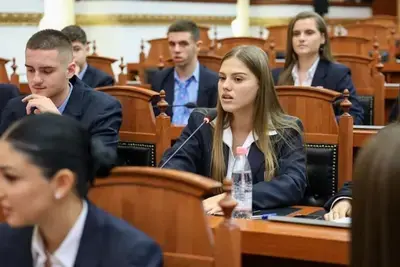
North Macedonia has worked hard to strengthen its democratic institutions on the path toward EU membership. A NATO member since 2020, the country’s Assembly has long faced challenges of transparency, limited citizen outreach and public trust. Since 2018, the Swiss Parliament Support Programme (PSP) implemented by the National Democratic Institute (NDI), has partnered with Parliament and civil society to address these gaps by building a legislature that is more open, accountable and connected to citizens.
When Aidan Eyakuze, CEO of the Open Government Partnership (OGP), visited Skopje in early September 2025, his message was clear: North Macedonia is setting the pace for open governance.
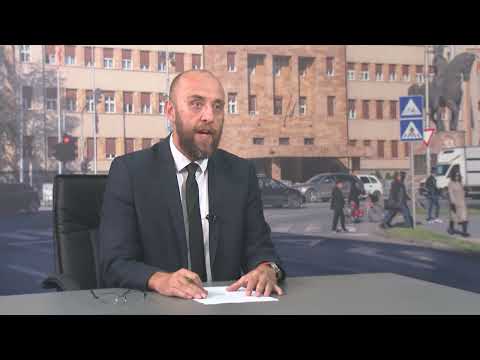
“North Macedonia is a leader, certainly in Europe, for opening up the state,” he said in his interview on Parliament TV. “Not just the executive, but also the judiciary and the legislature. That ambition is rare, and it should inspire others.”
North Macedonia’s Open State approach–with the legislature, judiciary and executive each developing and implementing specific reform commitments–sets the country apart, turning it into a reference point for peers, both in Europe and beyond.
Building an Open Parliament
Given its role as a lawmaking and oversight body, the parliament plays a particularly key role in North Macedonia’s Open State ambitions. PSP’s implementor NDI, with the civil society partners, the Centre for Change Management, and the Institute for Democracy Societas Civilis–Skopje, have supported the parliament since 2019 through three OGP Action Plans (2018–2020, 2021–2023 and 2024-2026).
The implementation of these plans has yielded important benefits. For instance, citizens can now access the Parliament’s budget, explore information through a modernized parliamentary website, and use an open data portal that makes legislative work searchable and reusable. A registry of civil society organizations has brought the public into policy discussions, while expanded live streaming of plenary and committee sessions and the planned opening of an e-archive ensure parliamentary debates and records are visible in real time. These steps, combined with early investments in Parliament TV, created the infrastructure that now enables deeper engagement and transparency.
Parliamentary Caravan: Bringing the Parliament to the People
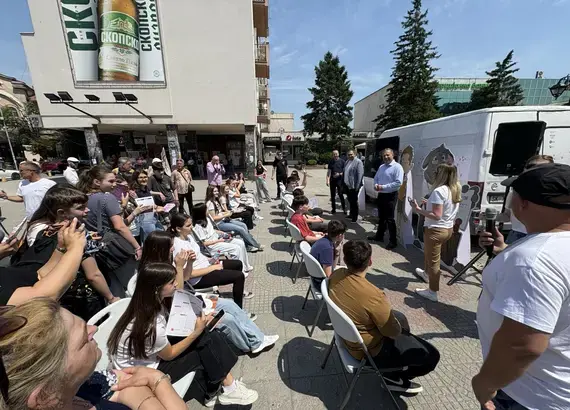
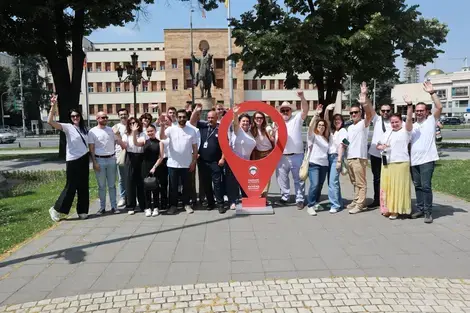
One of the most visible achievements of the current Action Plan is the Parliamentary Caravan–“Parliament for the Citizens.” Between May and June 2025, the Caravan reached 10 cities, covering over 2,040 kilometers (1,268 miles) and engaging 2,376 citizens, 54 members of parliament (MPs), and 74 parliamentary staff. For many, it was their first opportunity to meet MPs outside an election campaign. Children joined in too, contributing more than 175 drawings on what democracy means to them. “It was inspiring to see parliamentarians go out of the capital and meet people directly,” Eyakuze reflected. “That’s a story I want to take to other OGP countries: don’t just meet citizens during elections—make it part of your duty.” The Caravan shows how parliaments can build trust: by meeting people where they live, listening to their concerns and engaging them as partners in governance.
Delivering Democracy to Every Home
Another breakthrough came with the launch of the Parliament TV Channel, a 24-hour platform bringing legislative work into citizens’ homes. First envisioned in 2018 and officially launched in January 2024, the channel now broadcasts parliamentary debates, legislative briefings and original studio productions. By mid-2025, it had produced more than 150 hours of studio content and was broadcasting around the clock, with video-on-demand available online.
While viewership is still modest, satisfaction is high: 89 percent of viewers report being “somewhat” or “very satisfied” with programming. PSP played a crucial role by financing equipment, supporting staffing and training, and facilitating study exchanges with counterparts from the French Parliament TV studio. Today, Parliament TV stands as a practical symbol of transparency, allowing citizens to watch democracy in action.
Partnerships Driving Progress
None of these achievements happened in isolation. The PSP has been a steady partner throughout, supporting the Parliament to co-create action plans with civil society, monitor commitments and strengthen institutional capacity. According to the July 2025 monitoring report, the Parliamentary Caravan was fully implemented ahead of schedule, Parliament TV has moved from idea to daily practice with expanded programming and staff, preparations are underway for an Oversight Hearing on the National OGP Action Plan, and work has begun on a Register of Regulatory Bodies to make appointments more transparent. These milestones highlight how sustained support and inclusive processes are turning commitments into tangible results.
Looking ahead, Eyakuze underscored the link between openness and EU accession: “Joining the European Union is not just a technical process, it’s also a political project. Citizens must feel they have had a voice, that they’ve been respected. Otherwise, reforms risk losing public support.” Embedding transparency and participation in everyday governance is how North Macedonia can both prepare for EU membership and strengthen its democracy for the long term.
Openness in North Macedonia is no longer just an aspiration. It has become MPs listening to citizens in their communities, a 24-hour TV channel broadcasting debates and consultations that shape laws. The Parliament, with the support of the Swiss PSP implemented by NDI, is proving that openness builds trust at home and credibility abroad. On October 6-10, 2025, the Assembly and PSP/NDI shared their experience at Open Parliament Day and the OGP Global Summit in Vitoria-Gasteiz, Spain—demonstrating that even a small parliament can inspire big ambition and that transparency is a cornerstone of both EU accession and a resilient democracy.
Read his blog “North Macedonia’s Parliament in Action” here:
https://www.opengovpartnership.org/stories/north-macedonias-parliament-in-action/
Watch Aidan Eyakuze’s full interview on the Assembly TV Channel here:

More Success Stories
View All 
Kosovo